

The architecture on one page
A single sheet showing how the parts fit: where positions come from, how they are changed, and where each derivation has to stop.
DERIVATIVE PUBLICATION
One-Page Visual Architecture R1, accepted by the project as derivative exposition. It was produced under the
project's earlier name, Bounded Normative Authority (BNA), and predates the amendments accepted on 2026-10-02 and 2026-10-03. Canon
controls. Source publication/visuals/BNA-One-Page-Visual-Architecture-R1.png, SHA-256 cba47b0af8da1b51e8c4071b7547d93eaa517a5b064a942bb5b39da5f362f73c.
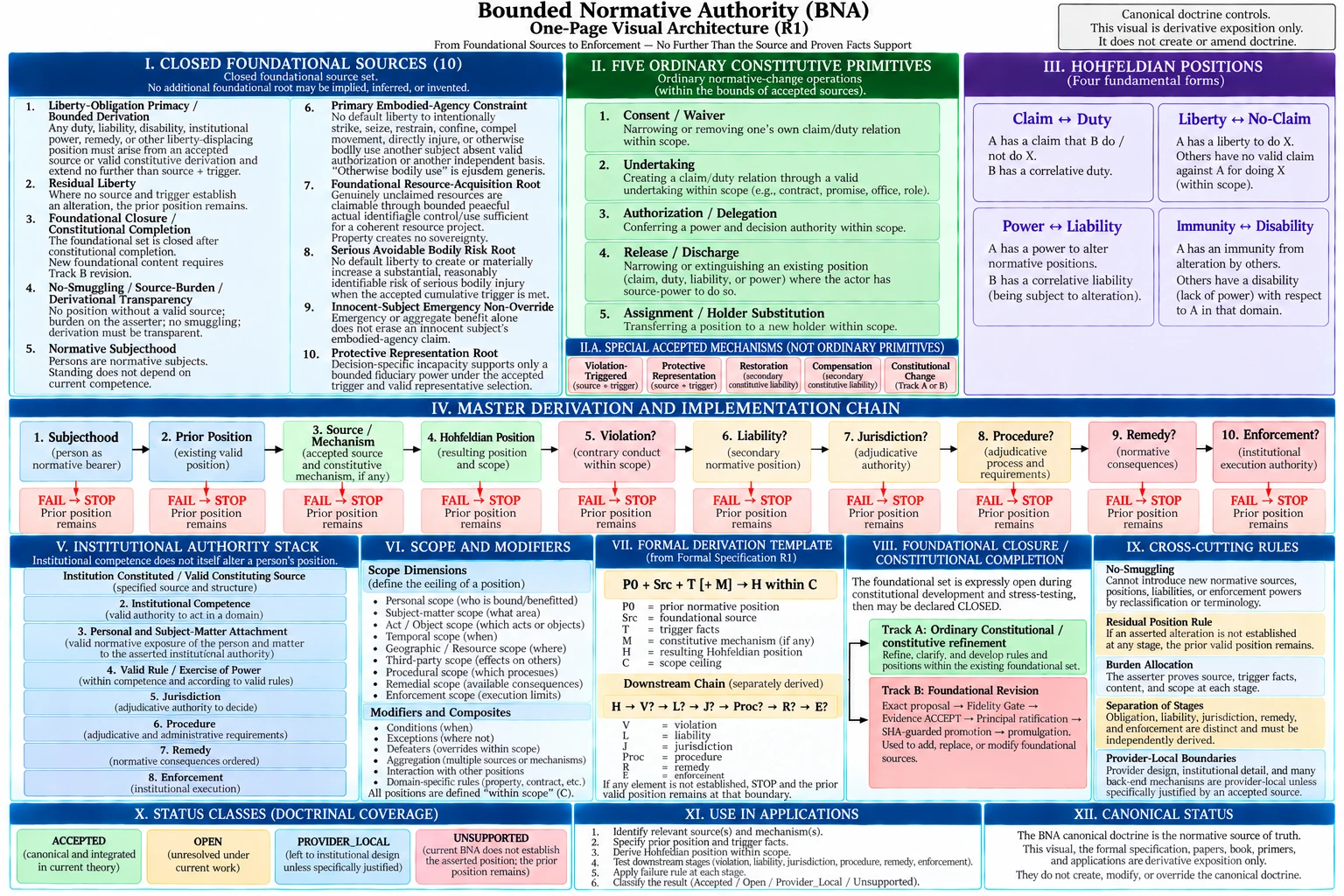
What the sheet shows
The visual has twelve panels. In reading order:
- Closed foundational sources. The ten sources, with the note that no further root may be implied, inferred or invented.
- Five ordinary constitutive primitives. Consent or waiver, undertaking, authorization or delegation, release or discharge, and assignment, with the special mechanisms listed separately.
- Hohfeldian positions. The four pairs: claim and duty, liberty and no-claim, power and liability, immunity and disability.
- Master derivation chain. The ten stages from subjecthood to enforcement. Under every stage: fail, stop, prior position remains.
- Institutional authority stack. Constitution, competence, attachment to the person and matter, valid exercise, jurisdiction, procedure, remedy, enforcement.
- Scope and modifiers. The dimensions that set the ceiling of a position: who, what, when, where, toward which third parties, and by what procedure, remedy and enforcement.
- Formal derivation template. Prior position plus source plus trigger, with any mechanism, yields a Hohfeldian position within a ceiling. Downstream stages are separately derived.
- Foundational closure. The foundation is open during development, then declared closed. Ordinary refinement and foundational revision are shown as separate tracks.
- Cross-cutting rules. No smuggling, the residual-position rule, burden on the asserter, separation of stages, and the limits of provider-local rules.
- Status classes. Accepted, open, provider-local and unsupported.
- Use in applications. Six steps for applying the architecture to a case, ending in classification of the result.
- Canonical status. The visual is derivative exposition. It does not create, modify or override doctrine.
Interactive derivation diagrams are planned for the Lab and do not exist yet.